Some artists get all the luck, and likes.
I know, I know, one should not use generative AI for trivial pursuits, but I was not going to count on my hands the thousands upon thousands of YouTube videos devoted to John Singer Sargent. So, in a moment of weakness, I asked you-know-who.
And the results did not surprise me. According to that resource hungry scraper and aggregator, when comparing searches on YouTube for James McNeill Whistler with John Singer Sargent, “The ratio is roughly 4:1 in Sargent’s favor.” Amongst the general viewership, Bob Ross is the most searched for artist on YouTube, but according to my chatty friend, Sargent in the most searched for amongst artists looking for other artists. How it knows who we are I don’t know, but the AI verdict is in. If you are painter looking to improve your painting, you search for JSS (Zorn was second, and Sorolla third by the way).
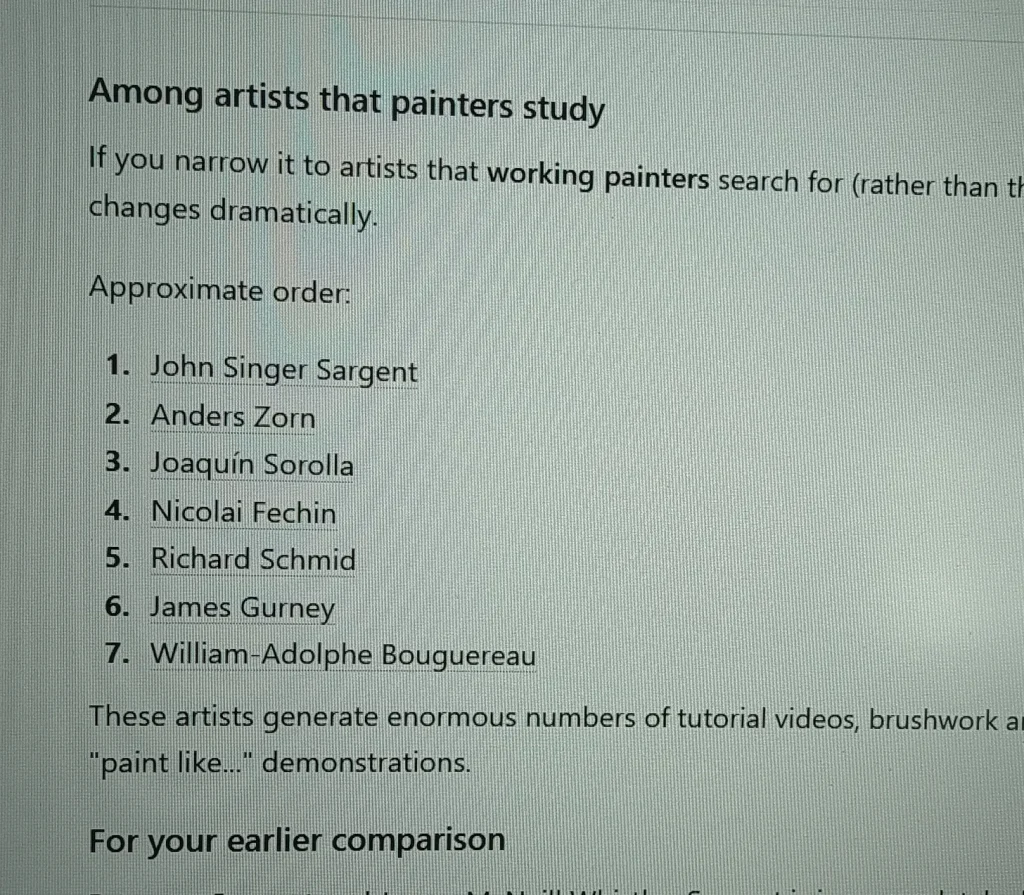
Even if the AI’s numbers are bunkum, my eyes aren’t and the number of social media posts on JSS have been increasing in recent years. About three years ago I thought it must be a blip, that over time content creators would branch out and try to find different horses to back for those precious watch hours that lead one down the gold paved boulevard, or the King’s Road, to monetization.
Don’t get me wrong, I have nothing against Sargent, he was indubitably a master painter; well trained, diligent, sure in his handling of the medium, professional, prolific. But a 4:1 ratio? Against Whistler? Painters come on! How many ladies in evening gowns or men with muttonchops do you need? Going back a few years on Instagram I commented on a post by a young man who was waxing lyrical about Sargent and selling online painting courses. I suggested that there was no point looking at Sargent without looking at Velasquez, from whom Sargent lifted a lot of his chops. Guess who his next “Paint like so-and-so” course was on. Did I miss a trick? Maybe, though online courses are not my bag of marbles, because I hate editing video.
More recently, last week in fact, I commented on another Instagram post that Sargent was good but not a genius (that’s where it’s at now). Another young man in a lengthy reply told me that Sargent was “ahead of his time”. I pointed out that Picasso and Braque had formulated, developed and completed Cubism while Sargent was still painting satin ribbons. The young man’s claim was based on Sargent’s habit of leaving wide areas of the canvas very loosely worked. He claimed this presaged abstraction. The flaw in this theory being that painters have often left unimportant focal areas loosely worked or even unworked ala non finito. Yes, Sargent did this, but so did Gainsborough and Caravaggio.
I am team Whistler. Unequivocally. Yes he got into blazing rows, threw punches, jumped onto railway tracks to run away from station staff, painted a whole room in someone else’s house while they were away, doodled in the margins of military maps, vented in newspapers and disappeared to Chile, but he was a proper artist; searching, inquiring, pushing himself and transporting the viewer. His technique was no less accomplished that Sargent’s and his skill in composition significantly better and more original. He extended himself and looked for possibilities.
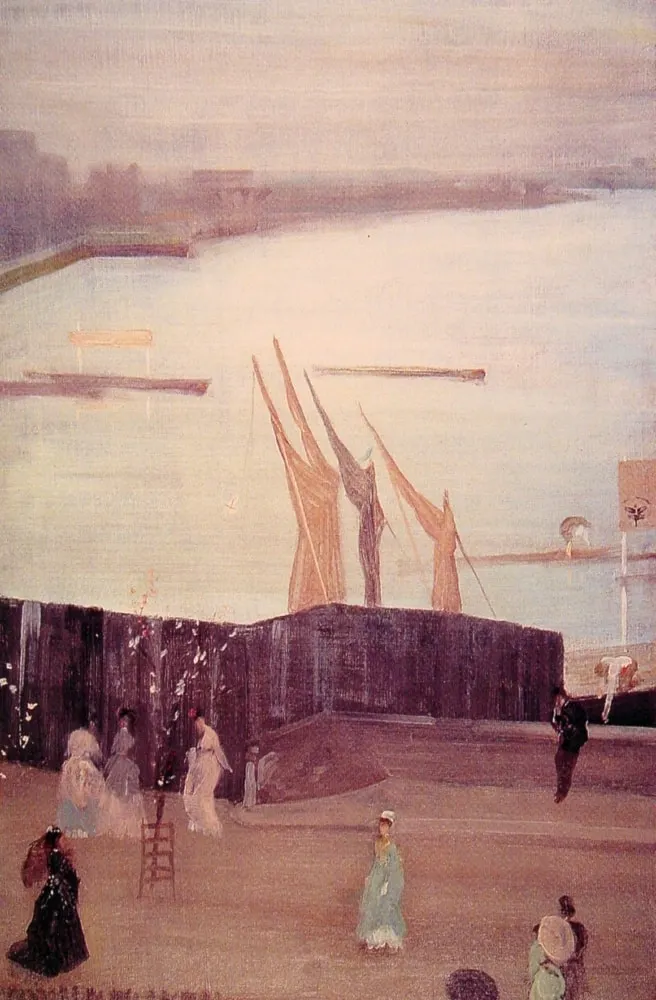
So why Sargent at 4:1? The bandwagon of content creation no doubt has something to do with it; it must be tempting to grab a bit of that JSS pie for one’s own channel. I also tend to think that Sargent is appealing because his brushwork is easy to see and his paintings reproduce well on digital screens. This quality in his work may have been dictated by subject matter. The success, that is positive reception, of high society portraits and nice images of nice people relies heavily on them not being mysterious or subtle. His early run in with the pearl clutchers and Madame X’s shoulder strap is well documented in those thousands of YouTube videos. He managed to regain his professional footing by painting the strap back on the shoulder, and he was willing to do this. That’s important. A more emotionally attached and less regulated artist, a Whistler perhaps, would have fired off a letter to the journals or published a pamphlet decrying the ludicrous and highly hypocritical mores of the monied and great. Not so Sargent. The bread shall remain buttered on the correct side, after all, an atelier is a business. His nicely painted paintings of nice people now turn out to be perfect for small digital screens; clear tonal arrangements, sensible compositions that can be spare but not too abstract, just enough “vibe” to be engaging without being suggestive. Easy to look at, easy to understand.
That he doesn’t cover his tracks with techniques that hide brushwork makes him instructive for contemporary painters who are both screen addicted and averse to very slick imagery. The attraction to his output lies in his skill in producing a surface that wasn’t overly worked yet controlled, and attendant to verisimitude. Good portrait painting in a nutshell. I can understand the appeal, but I can’t understand the lobsidedness of attention. If there were no YouTube, would Sargent’s output be receiving anything like the attention it currently is? Is it because the work is that good, or because virality and monetization drive decisions about content?
There’s always a lot of cat fighting and argy-bargy about art history, who writes it and who doesn’t, who gets into the canon and who gets fired out of it etc., but have we come to a point where content creators start to influence who gets canonised as “genius” based on algorithms, thumbnails, follower counts and factors that have nothing to do with art?